Skateboards and prams: how a place becomes everyone’s | SK8ABLE
“The city belongs to everyone.” – Valeri Gyurov
Skateboards and prams: who says they can’t share the city?
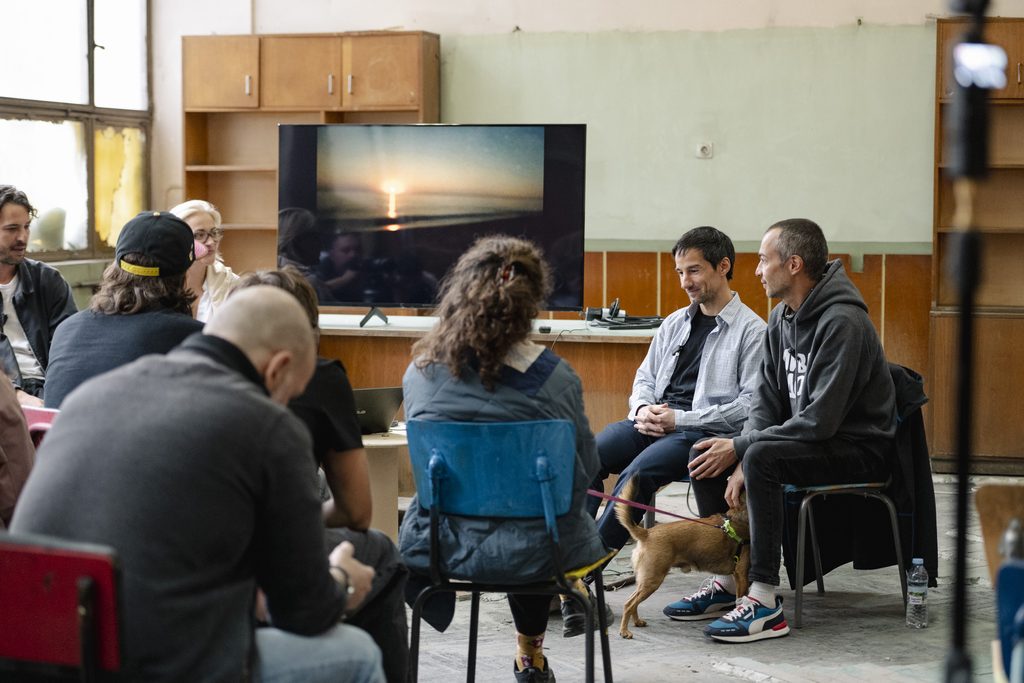
During SK8ABLE at the Christo and Jeanne-Claude Center, architects and skaters discussed how a well-designed place can be for everyone – and why this matters for the future of Gabrovo’s riverside alley.
“Right, let me put the classic claim on the table: where there are skaters, there are no mothers with prams.“
With this provocation, Margarita Dorovska, director of the Christo and Jeanne-Claude Center, opened the discussion on skateboarding and the urban environment, held during the opening weekend of the SK8ABLE project (25–27 September 2026).
The panel brought together three architects: architect and skater Viktor Berger; Stanimir Semov, co-designer of the riverside alley project; and Valeri Gyurov, who has followed street cultures for years.
The answer to the provocation came straight away:
“Well, that’s not true. The spot at NDK is used by lots of people pushing babies in prams, and people rollerblade there… In my view, it’s not impossible for one place to be used by different groups. At the very least, they don’t overlap in time – they are active at different times of day,” said Valeri Gyurov. (NDK, the plaza around Sofia’s National Palace of Culture, is Bulgaria’s best-known street skating spot.)
An idea born at the kerb
In the early 1970s, in Berkeley, California, students with disabilities campaigned for the kerbs at street corners to be lowered, so that wheelchair users could cross on their own. In 1971 the city council ordered this at 15 corners. The dropped kerbs turned out to serve a much wider group of people: parents with prams, travellers with wheeled suitcases, couriers and cyclists.
Angela Glover Blackwell called this the “curb-cut effect”: when you design for the people most often left out, everyone wins. The discussion at the Christo and Jeanne-Claude Center showed that the same logic applies in Gabrovo to groups that are usually said to be incompatible – skaters, people with different physical abilities and parents with prams.
“So that it truly belongs to everyone”
For the Center, accessibility is not a theoretical question; it is one of the main issues in the renovation of the building.
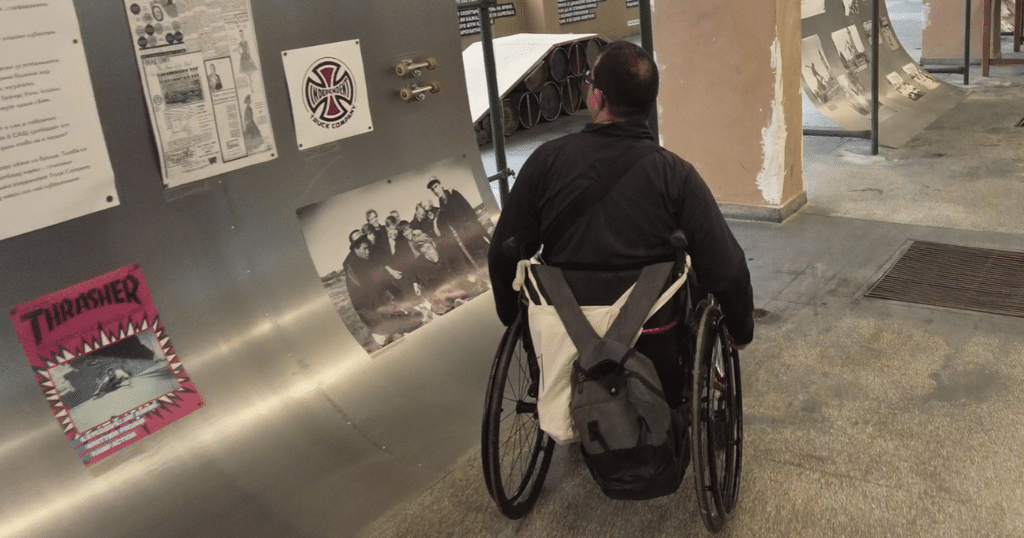
“When I worked at the Museum of Humour and Satire, many accessibility measures were introduced there, supported by the Agency for People with Disabilities. In an existing building, such measures always turn out to be partial and, in the end, only partly effective,” said Margarita Dorovska. “When we started working on the idea of renovating the Center, this was one of the big themes: making the space accessible so that it truly belongs to everyone – not added as an afterthought, but considered from the very start of the design. The AccesS project, in which the Christo and Jeanne-Claude Center is one of six pilot locations, plays a major role in this.“
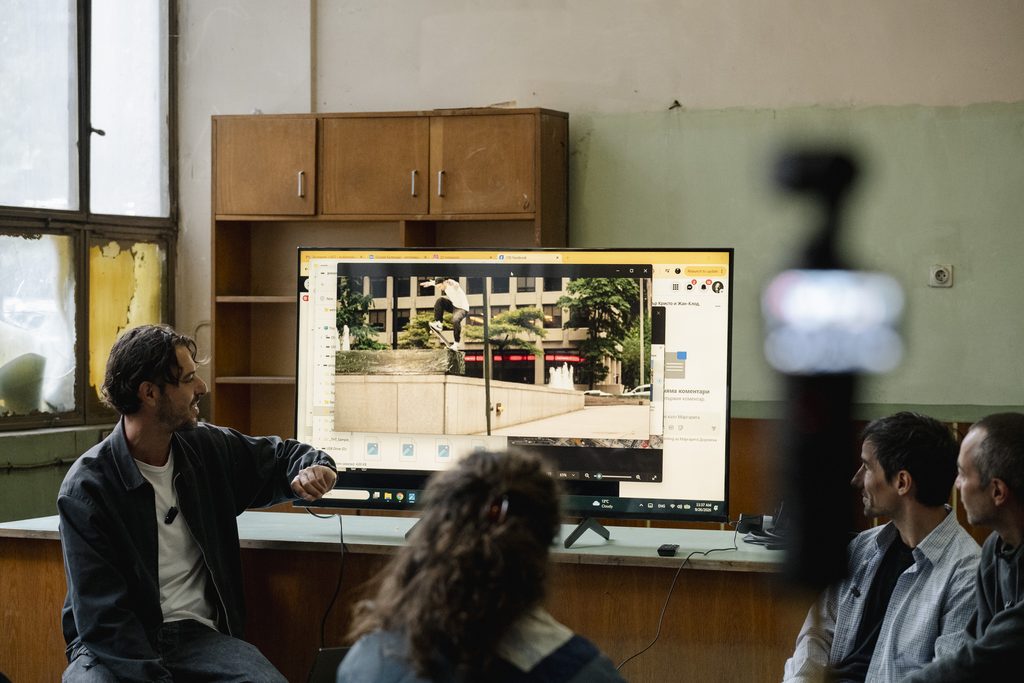
She also showed a short video telling a popular story from the United States: how the Americans with Disabilities Act (ADA), passed in 1990, standardised ramps and handrails in cities – and unintentionally created some of skaters’ favourite spots. “It’s a wonderful example of how different groups of people share similar interests,” Dorovska commented.
How a place is shared
The architects’ answer is simple: shared space does not just happen – it is designed.
Stanimir Semov recalled the competition design for Place de la République in Paris: “One of the slides had a drawing, a graphic, showing exactly that coexistence – skateboards, prams and mothers, cafés, cultural events – and how the space lives all day long.” When the square empties, he added, skaters appear and bring it to life.
Viktor Berger showed another Parisian example: a 150-metre street turned into a small art skatepark. “Skate features don’t have to be only grey – granite and concrete. They can be beautiful, made with taste, and delight skaters and casual passers-by alike.“
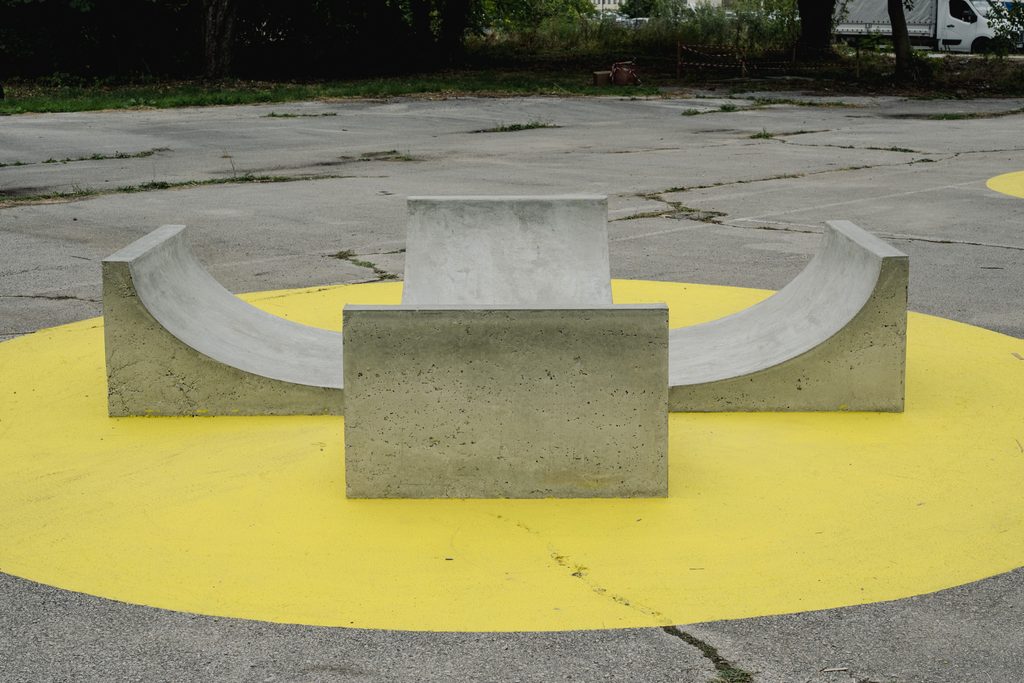
The riverside alley project in Gabrovo rests on a similar logic: small granite squares, benches with low edges, gentle slopes, a cycle lane, a pump track and steps down to the river. These are features that walkers, children on bikes and skaters can all use. “We’ve tried to fill the space with enough functions so that there are people there at any time of day or night,” explained Stanimir Semov.
This is old urban wisdom. In her book The Death and Life of Great American Cities (1961), the urbanist Jane Jacobs called it “eyes on the street“: a place where people are always present is safer for everyone. Families in the morning, skaters in the afternoon and evening, walkers all day long – each looks after the place for the next.
Lessons from LOVE Park
One of the strongest examples comes from Philadelphia. Viktor Berger told the story of LOVE Park, a plaza opposite the city’s City Hall which, in the early 1990s, had fallen into neglect and was avoided by passers-by, despite lying right in the centre.
“Skaters start coming – they hang out there, they skate – young people, kids of 15 or 16. Over time, people see that if they can be there, we can walk through too. Little by little, the park is reintegrated into the urban environment. […] Skating can have a good influence on the urban environment,” said Viktor Berger.
The story, however, has a sequel, because Philadelphia did not accept its skaters. The first ban on skating in the park dates from 1984, and from 2002 Mayor John Street’s administration enforced it with a $300 fine. That same year, 92-year-old Edmund Bacon, one of the plaza’s designers, rode across it on a skateboard in protest. In 2004 the brand DC Shoes offered to pay for the park’s upkeep if skating were allowed – the city refused. And the 2016–2018 reconstruction removed the very features that had made the plaza famous among skaters worldwide.
In 2024 the Swedish city of Malmö announced that it had acquired the plaza’s original granite in order to rebuild part of it for skaters. One city sees skaters as a problem and loses its iconic site. Another sees them as an asset – and literally buys the stones.
Who’s afraid of skaters?
The usual complaints are that skaters are noisy and break things. Viktor Berger has an answer any builder would understand:
“People accuse skaters of breaking and wrecking things, but if a park is clad in cheap 2-centimetre Chinese stone, it will crack as soon as you jump on it. […] In socialist times they built with 6-centimetre granite slabs – a lorry could drive over them and they wouldn’t break.“
What is more, skaters look after the places where they skate. On the plaza in front of NDK in Sofia, a broken slab lay unrepaired for three weeks, Berger said. Two skaters came along and filled it with concrete – “so that it could be skated and, above all, so that it wasn’t dangerous“.
Prejudice, however, persists. “The first thing a friend said to me when I told him my son had started skateboarding was: ‘Be very careful, there are loads of drugs there.’ […] There’s that stigma,” one of the participants said.
Valeri Gyurov also pointed to a more worrying trend – so-called hostile architecture: “There’s a trend of architects deliberately adding obstacles, such as round knobs on handrails or spikes, so that things can’t be used beyond their decorative purpose. It’s a very sad phenomenon.“
A scene that can be seen
Why does all this matter for Gabrovo? Because residents have said clearly what they want. “When the survey on the riverside alley was carried out – asking what people wanted from its renovation – one of the things that came up was a skatepark,” Margarita Dorovska reminded the audience.
Skating, like any culture, survives only if it can be seen. “A kid walks past and sees the older guys jumping and the board spinning under their feet – that’s attractive. There has to be a scene,” said Viktor Berger.
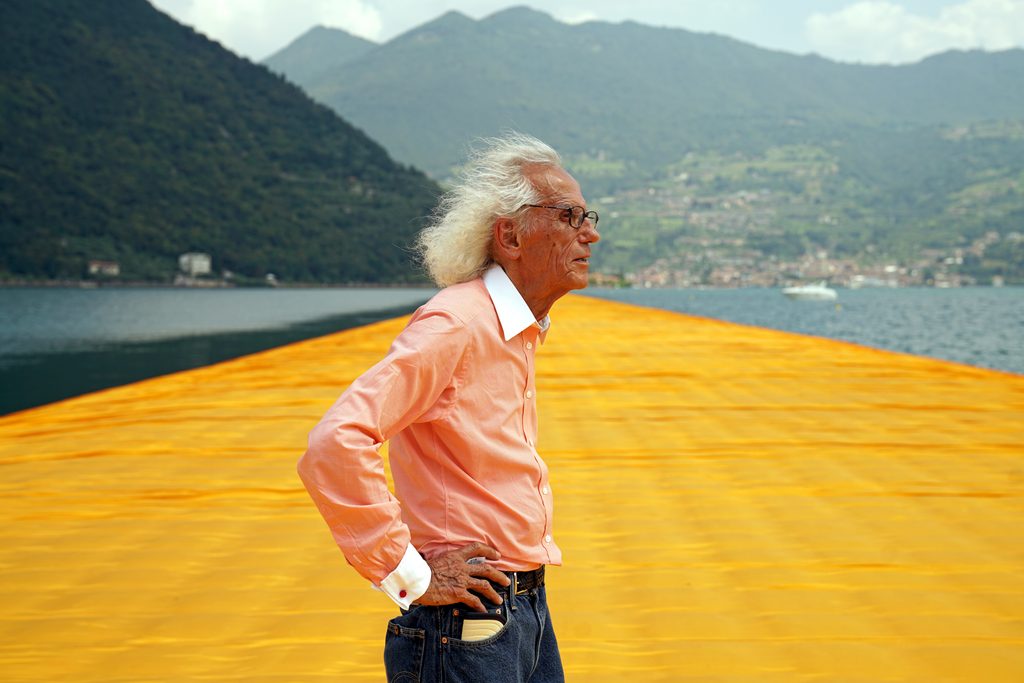
The link with Christo is closer than it might seem. “He takes an oil barrel and it’s no longer a barrel, but an installation. In the same way, here we don’t have steps – we have an installation where something fun can happen,” noted Valeri Gyurov.
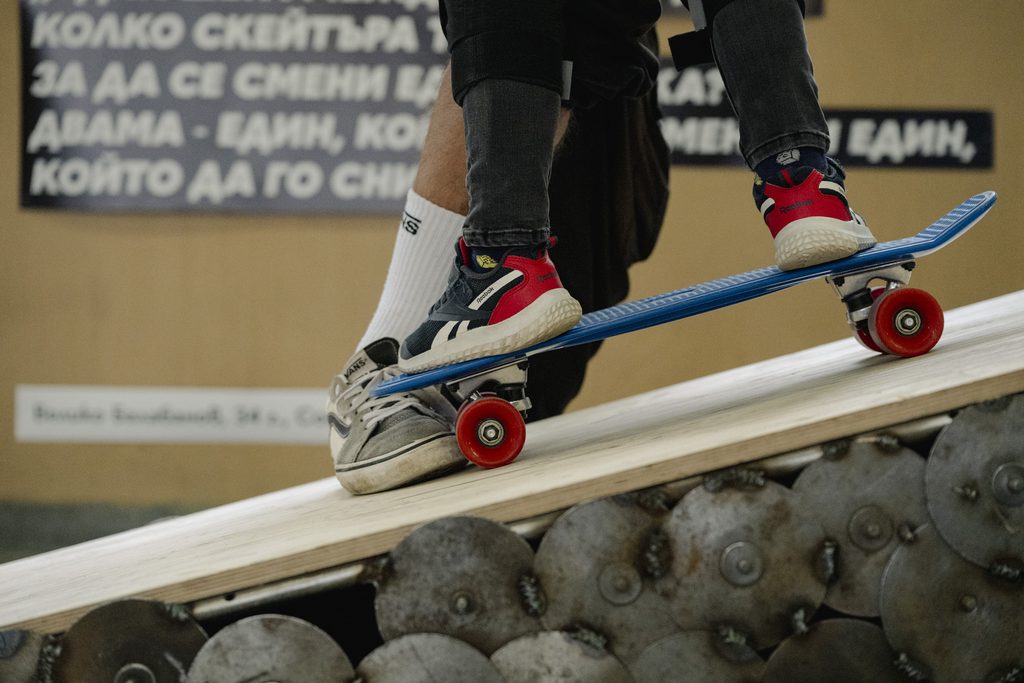
The skate sculptures by XPOME and Rabotilnitsa Punkt in the Center’s yard and exhibition hall are exactly that kind of invitation: to look at the familiar in a new way.
The city belongs to everyone
The curb-cut effect shows that universal design does not choose between groups. The skater riding in the afternoon and the parent passing with a pram in the morning want the same things: solid paving, a place free of artificial obstacles, and a city that does not chase them away. Or, in the words of Valeri Gyurov:
“The city belongs to everyone – not to the architect who designed it, or to the person who paid for the bench.”
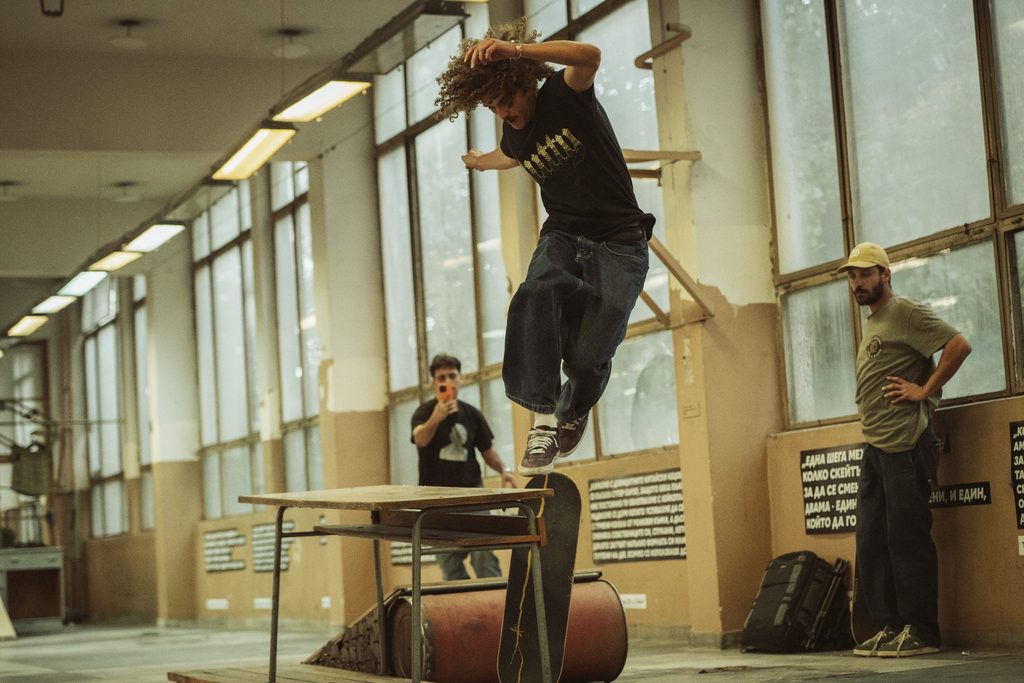
The SK8ABLE exhibition on the history of skateboarding in Bulgaria remains at the Christo and Jeanne-Claude Center until 31 May 2027, and the skate sculptures by XPOME and Rabotilnitsa Punkt remain in its yard and building at 72 Bryanska Street, Gabrovo (entrance from the river side). Opening hours: 13:00–19:00. Admission: free.
Photographs: Boryana Pandova and Wolfgang Pulz